
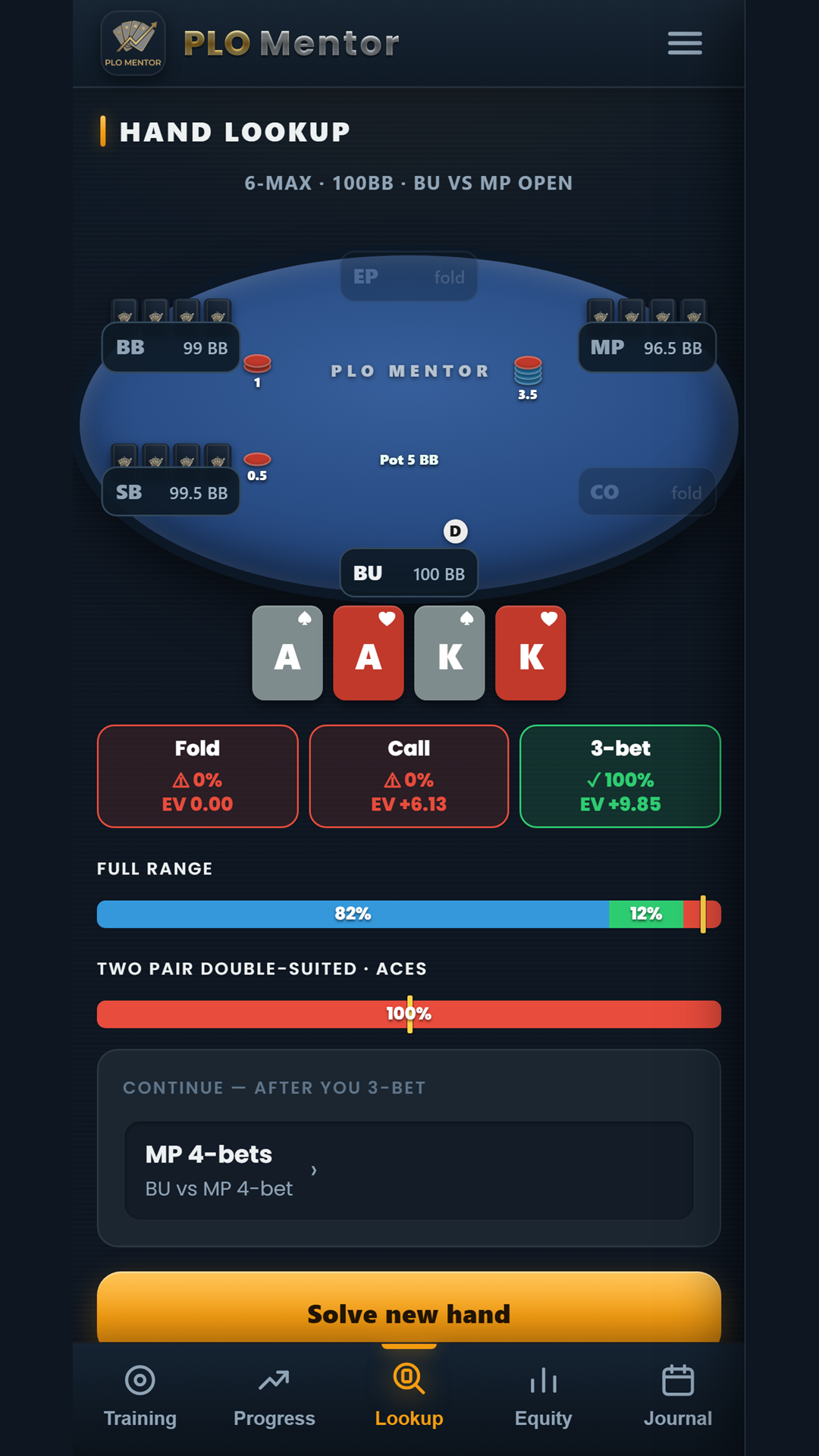
The PLO Mentor Lookup Tool helps you review a specific preflop situation after the hand has been played. Instead of training a random drill, you select the exact spot, enter an individual hand or inspect a full range, and check what the solver recommends.
Designed for post-session study
The Lookup Tool is especially useful when you want to revisit a hand from your own game. Choose the relevant preflop situation, look up the exact combination or range and see whether the solver prefers a fold, call or aggressive action.
Check an exact hand or a full range
You can use the tool in two complementary ways. First, you can check a single hand to see the direct solver recommendation. Second, you can inspect the surrounding range to understand whether the hand is a clear action or part of a mixed boundary.
Learn from mistakes after the fact
Lookup is built for players who want to understand errors after a session. If a hand felt unclear in game, the tool gives you a structured way to review it later and connect the answer back to range logic, hand categories and EV.
How Lookup fits the PLO Mentor workflow
Use Lookup when you want a precise answer to one hand or range. Then use the Trainer and Leak Finder to reinforce the pattern through active practice. In that way, Lookup becomes a bridge between played hands and long-term improvement.
Frequently asked questions
What is the Lookup Tool for?
It is for reviewing a specific preflop situation and checking the solver-recommended play for an exact hand or hand range.
Is Lookup a replacement for training?
No. It is a review tool. Lookup explains one hand or range, while the Trainer and Leak Finder help you practise and retain the pattern.
Can I use Lookup after a session?
Yes. That is one of its main uses. Save the hand mentally or in your journal, then look it up later and compare the answer with your in-game decision.
Does the tool show one exact answer only?
It can show a single-hand recommendation, but it is most powerful when you also inspect the surrounding range and identify whether the hand belongs to a broader strategic pattern.