
The new PLO Mentor Lookup Tool is built for a very common study question: what should I have done in this exact preflop spot? Instead of waiting for the same situation to appear again in a random drill, you can review it directly after the session and check the solver recommendation.
\n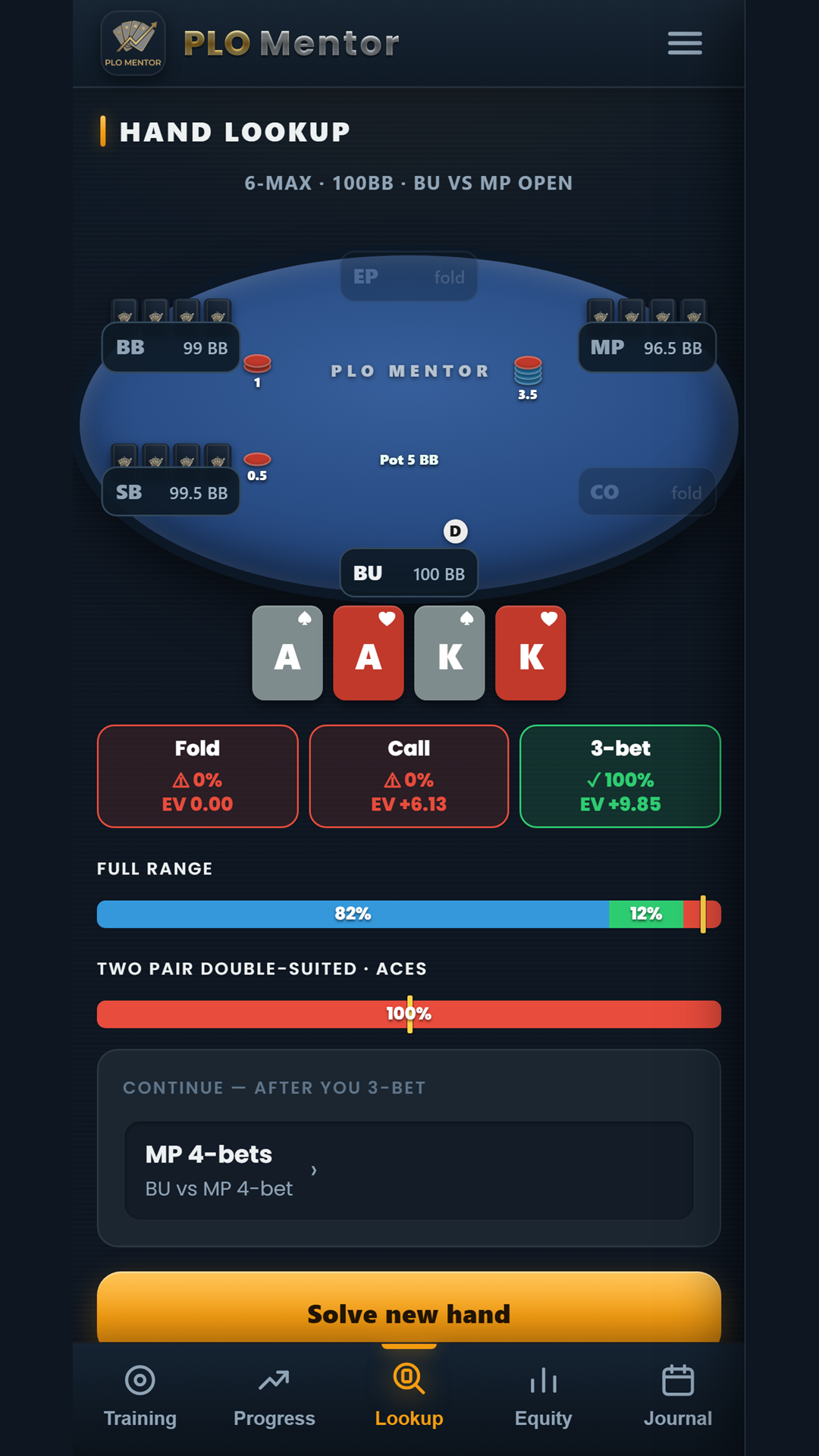
Step 1: Start with the exact situation
Good review begins with context. Identify the relevant preflop sequence first: the position, the prior action and the stack depth or blind structure shown in the tool. The same four cards can change value dramatically between positions and action trees, so the lookup process should always begin with the correct spot.
Step 2: Enter the exact hand
Once the situation is defined, use Lookup to inspect the exact hand you played. This is the fastest way to answer the immediate question of whether the solver prefers a fold, call, raise or more aggressive action.
Step 3: Check the surrounding range
Do not stop at the single-hand answer. The most valuable study happens when you compare the hand with the wider range. Is your hand a pure action? Is it near a mixed boundary? Does one side card or suit change the recommendation? Seeing the neighbourhood around the hand turns a one-off answer into a transferable idea.
Step 4: Ask why the solver prefers that action
The review is not complete until you understand the driver behind the answer. Maybe the hand makes nutted outcomes more often, blocks key continue hands, or suffers from disconnected side cards. The goal is not merely to memorise the result but to recognise the strategic reason for it.
Step 5: Reinforce the lesson in training
Lookup tells you what the solver wants in that one spot. The Trainer and Leak Finder help you retain the pattern by presenting many related decisions later. This is what turns post-session review into long-term improvement.
Best use cases for Lookup
- Hands that felt unclear during a live or online session
- Borderline opens, defends and 3-bets
- Hands that produced a costly result and deserve calm review later
- Category study, where one exact hand highlights a broader pattern
A simple workflow is: save the hand in your notes or journal, review it in Lookup, inspect the surrounding range and then launch a relevant drill. That process is efficient, repeatable and much more useful than relying on memory alone.